Many educators, parents, adults, and students may be wondering what is this, why are we doing this, and how do we even start. This post’s purpose is to help you solve all of your burning questions. Let’s begin with the what.
What Is Technology in the Classroom?
Technology in the classroom is an aide. It is there to assist in learning and make it more purposeful. Maybe you remember a time where you sat in class and the teacher lectured the whole time. Maybe you found school to be boring or uninteresting. Maybe you have a hard time even remembering what you learned in school. All those statements are reasons to start on this journey to using technology in the classroom. The purpose of technology is to not be a game or toy for students to use. It is simply to deepen the learning of the students so they aren’t bored, aren’t uninterested, and they do remember what is being taught. Studies have shown that hands on learning is far more beneficial than lecturing and traditional styles of teaching. A post on Education Week by Katie Ash discusses a study that was performed by Purdue University. They had a classroom of students learn traditionally and a classroom of students learn hands on, and they had found the classroom that learned hands on had a deeper understanding of the content.
Why Should Educators Do This?
The fact of the matter is that times are changing. There is far more technology than there has ever been. With the development of tablets and other electronics, there is an opportunity to further our students’ learning. As mentioned in the previous section of this post, deeper meanings and understandings are created when using hands on materials and aides such as technology. Along with creating more substantial learning for our students, we are also helping them develop skills such as collaboration, creation, innovation, and problem solving. Walden University did an article on the ‘Top 5 Benefits of Technology’. Listed in this article are these- creates a more engaging learning environment, helps benefit multiple learning styles, improves collaboration, prepares students for the future, and helps teachers build better relationships with students. Technology can better our students, but we have to start using it today.
How Do We Get Started?
There are different frameworks to use depending on what you feel is best for the classroom and your students.
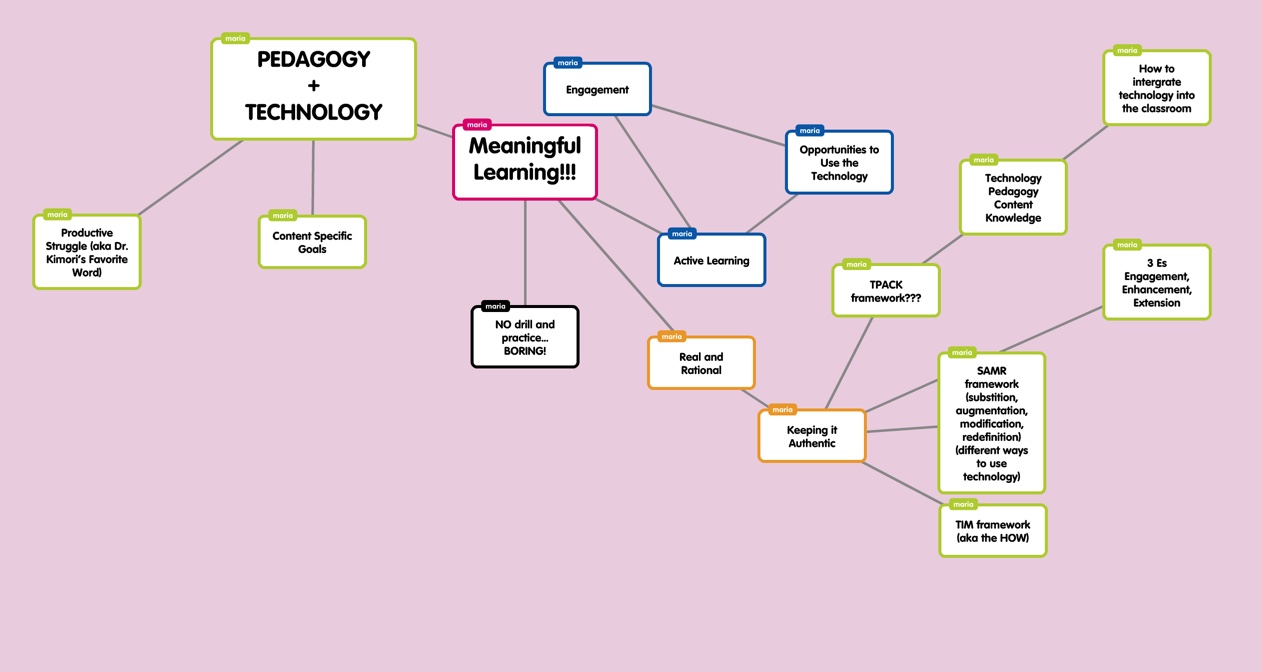
There are three different frameworks that can be used. The first is the TPACK framework. The TPACK framework focuses on three main components- content, pedagogy, and technology. First, the educator or instructor would choose a topic that they would like to teach. That would be the content. Second, the educator would choose how to teach it. This should be in response to the learners, meaning, it should be taught in a way that is best for the student. Lastly, the educator would choose which technology best fits both the content and the pedagogy.
The next framework would be the TIM framework. The TIM framework is similar to the TPACK framework, however, the TIM framework focuses in more on the technology. The TIM framework’s main focus is how to use the technology and what the technology being presented is.
The last framework that will be discussed in this post is the SAMR framework. SAMR stands for substitution, augmentation, modification, and redefinition. SAMR uses different forms as technology for typical use. An example would be to use Google Drive instead of Microsoft applications. The students would start to use Google Drive and then realize the benefits and drawbacks of what Google Drive has to offer in comparison to Microsoft.
Taking the First Step
In all, starting a new course of educating is challenging and present new obstacles. However, a lot of materials and good sources are available to those that are willing to take the leap into jumping into the new generation of learning. The bottom line is that learning needs to be more engaging, hands-on, and meaningful, and that can begin with using technology.
Citations
Walden University. 2019. Top 5 benefits of technology in a classroom. Retrieved from https://www.waldenu.edu/programs/education/resource/top-five-benefits-of-technology-in-the-classroom
Ash, K. 2009. Hands on learning vs. lecturing. Retrieved from https://blogs.edweek.org/edweek/DigitalEducation/2009/01/engaging_students_in_stem.html

 Technology 4 Future Educators